NVIDIA – 3 years of growth

NVIDIA released their July quarterly results today.

If you look at their results from a year ago and 2 years ago, the changes have been dramatic (click to enlarge):

You can read the whole story of a financial report using a Sankey diagram, and by using the same scale across years, you can see visually exactly how the story has changed over time by flipping between the images.

For a more interactive version of these graphs, and to see their other quarters’ results from recent years, visit the NVIDIA Data page.

Update: NYC Mayoral Democratic Primary figures as of 7/15

Once a week until the results are truly final, Vote NYC is posting updated counts and I am updating the graph accordingly.

The results have not changed significantly; in fact, the margin of victory for Mamdani over Cuomo has so far been slowly increasing.

I find it interesting to graph the various editions of the data for comparison. Here is a gallery of the three graphs so far, in sequence. They use the same scale, so the visual differences should be representative of the actual magnitude of the changes.

Data Source: Vote NYC > Ranked Choice Results > Mayor/Democratic > Interim Rounds

2021 NYC Mayor Primary Election

In anticipation of this year’s NYC Mayoral primaries (being held today), I’ve put together a diagram of the previous Democratic primary, from 2021.

A Sankey diagram of the 2021 New York City Democratic Mayoral primary election, which used ranked choice voting.

In the first round, the top 3 vote recipients were Eric Adams, Maya Wiley and Kathryn Garcia.

As candidates were eliminated and their votes flowed to other candidates, Garcia moved up to 2nd place in the 7th round. After Wiley was eliminated, Adams finally exceeded 50% of the remaining active votes.

Adams' margin of victory over Garcia was 7,197 votes.

The number of Inactive Ballots at the end (with none of the  remaining candidates ranked) was 140,202, far exceeding the margin of victory.

Some notes:

  • Only a few labels are shown on the diagram, specifically highlighting the changes between rounds.
  • The original votes for each candidate are in gray; any votes added to a candidate keep the color of the last candidate they ‘belonged’ to.
  • On the diagram’s page, you can click the ‘Edit with Sankeymatic‘ button to import the full diagram into the editor, to see exactly how it is made.

Data: New Microsoft Diagram (Sep 2024 Results)

I’ve added diagrams for Microsoft’s recent quarterly results.

Here is the most recent quarter vs. the same one a year before (using the same scale):

The pictures are quite consistent except for the $10M increase in Service revenue and the corresponding increase in costs.

Visit the Microsoft page for more.


One other note: the buttons I mentioned below which said “use this one as a starting point” are now updated to say “Edit with SankeyMATIC“, like so:

They do the same thing as before, but I think this design gets the point across better – more like the ubiquitous Edit on CodePen buttons you see on web tutorial examples.

Data: New NVIDIA & Apple diagrams

Some new example financial diagrams are posted – the latest quarterly results for NVIDIA and for Apple.

Thumbnail of NVIDIA's Q2 financial results as a Sankey diagram. The blue flow at the bottom right represents the net profit.
NVIDIA 2025 Q2 (ending July 28)
Thumbnail of Apple's Q2 financial results as a Sankey diagram. The blue flow at the bottom right represents the net profit.
Apple 2024 Q3 (ending June 30)

There’s a fun new feature on each of these pages as well:

The top diagram on each page now has a ‘public link‘ that lets you use it as the starting point for a diagram of your own. Just look for this on each page:

Text & a button, saying: 'Want to make your own diagram? You can use this one as a starting point'

Try out the links! You may encounter a new technique, or you may arrive at a better layout than I did. 🙂 Here are all 3: NVIDIA 2025 Q2, Apple 2024 Q3, Apple 2024 Year-to-Date.

Beyond the new make-your-own links, you’ll see some additional changes if you happened to visit those pages before:

  • The Data pages are now reorganized. Rather than having an extensive directory structure, there is now just one page for all of a company’s Quarterly diagrams and (in the case of Apple) another for its Annual ones. This should be rather less work to maintain, so hopefully it’ll be easier to keep them up to date.
  • There is now an index of thumbnails at the top of each page, to help give you a broad overview of recent history before you get into the details. (In data visualization terms, it’s a set of small multiples.)
    • The quarterly results are arranged in rows of 4 so that you can scan up & down to compare the same quarter across different years. This makes it easier to see at a glance, for instance, NVIDIA’s growth over one year’s time:
Thumbnails of diagrams showing NVIDIA's last 6 quarterly reports. Note the growth from Q1 2024 to Q1 2025.
  • The scale which is used for every diagram on a page is now listed at the top.

The next question you might ask is:

Why not use the same scale across all of these pages?

The short answer is, the companies are just too different in size. Considering just NVIDIA and Apple:

  • If you made NVIDIA use Apple’s scale, most of its diagrams would be pretty tiny, making it hard to arrange labels in any readable fashion. (See NVIDIA’s Q1 2024 for an example where the flows are already getting too small to comfortably label, even at the scale I chose.)
  • If you made Apple adopt NVIDIA’s scale, then Apple’s diagrams would be incredibly tall.

That’s why each page is considered independently in terms of which diagram scale will provide good readable diagrams at a reasonable size.

For fun, here’s what NVIDIA’s biggest-ever quarter would look like if it did use the same scale as Apple’s latest quarter (compare to the NVIDIA image above):

New Site Section: Data

I’ve added a new tab to the top menu bar: Data: Interesting Diagrams from the Real World.

The first examples there show financial results for companies over time, with the first (of several) being Apple.

You may have already seen such diagrams presented elsewhere in Sankey form. What’s new here is:

  1. Each diagram is overlaid on the same period’s results from the year before
  2. There’s a slider so you can compare them.

Here’s a static screenshot of one:
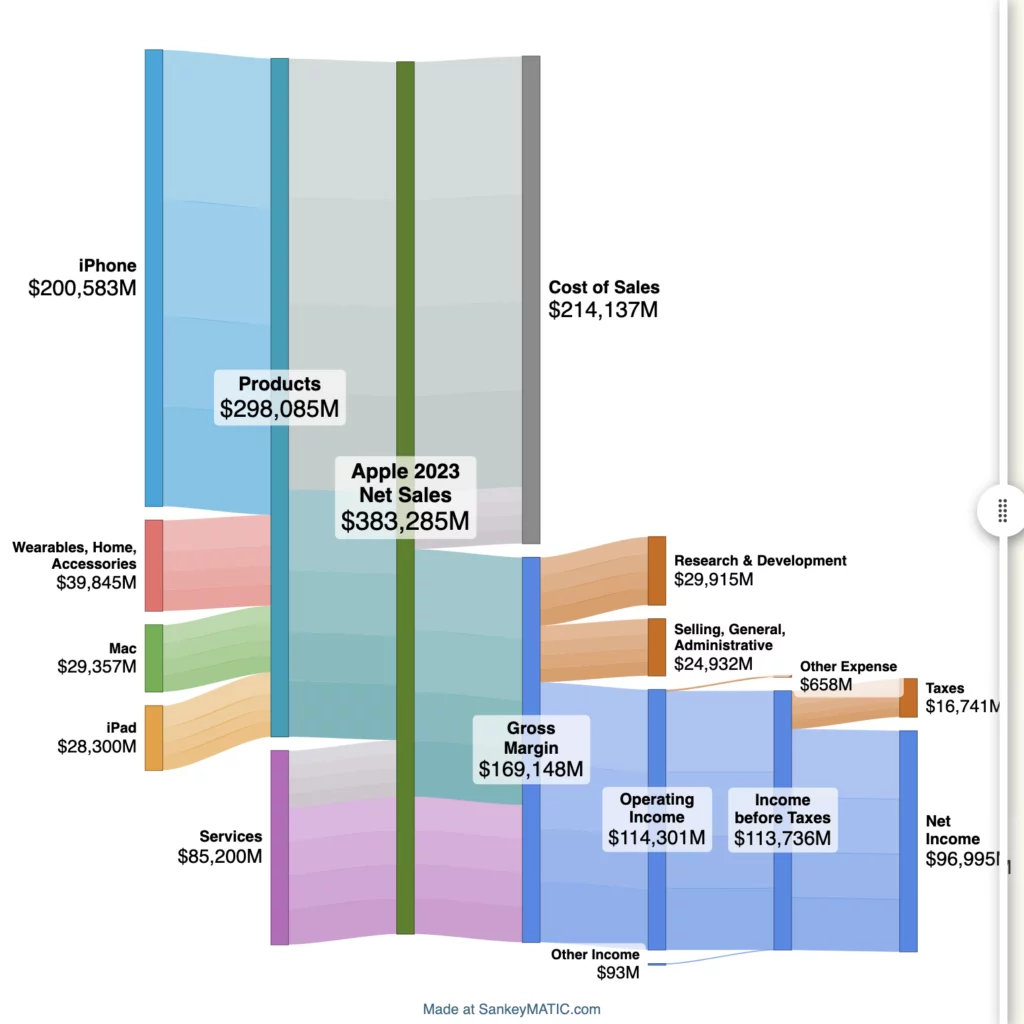
(Note that on the page itself, you’ll also get some highlighting & tooltips when hovering that you can’t see in this image.)

And here’s an animated example showing Apple’s 2024 results and a slider revealing the prior year’s results:
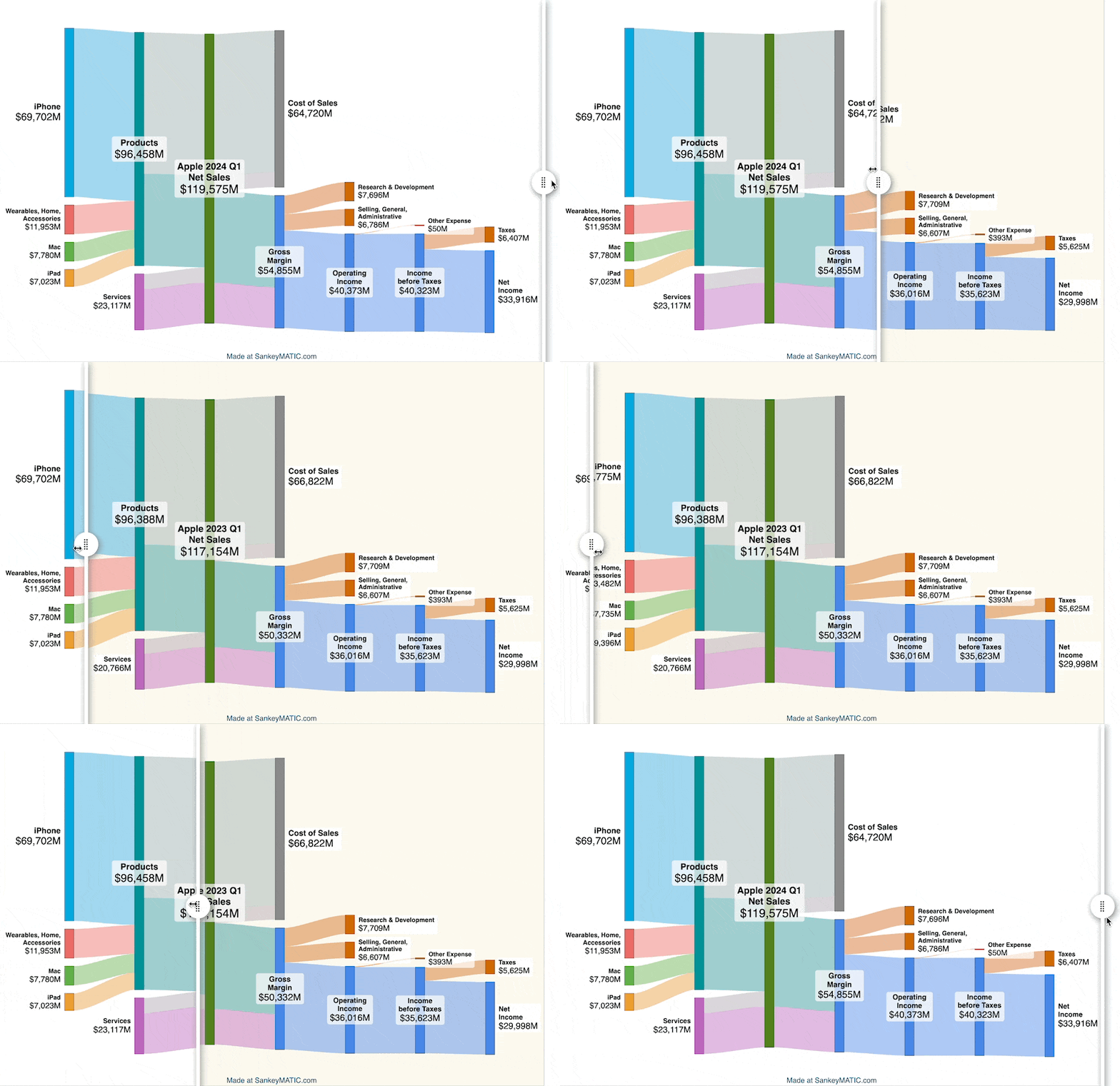
Animation. A sankey diagram describing Apple's Q1 2024 results is shown. 

A slider bar at the right of the diagram is grabbed by a mouse pointer and is dragged to the left of the diagram, revealing a diagram of Apple's 2023 Q1 results for comparison.

(cross-posted from vis.social/@SankeyMATIC)